

The work is getting done. Is it getting delivered?
Output is up, but costs haven’t gone down. The clients aren’t happier. The tools you paid for sit half-used. The board wants to see savings, and your team is quietly afraid.
Every leader rolling out AI is carrying some version of this. Most are treating the symptoms.
The cause under all six: the people who know your clients and the tools doing the work aren’t drawing on what the other does best.
Your people know the client: who they are, what they need, when the rule should bend. The tools bring speed, scale and consistency. Neither delivers alone.
AI can finish the task. It can’t tell if the client got what they truly needed.
Done is not delivered. A task can be finished to spec and still miss the need it was for. Your people catch it, because they personally know who it’s for. The client who needs the exception. The report that’s accurate and answers the wrong question. The problem upstream that nobody wrote into the spec.
People know people. Systems don’t.
That judgment is the asset. Most organizations cut headcount after they implement AI, and the judgment walks out the door with the first cut.
There is a better move. Equip the people who know your clients with the know-how to put AI to work, so every resource serves the people you serve. Delivered, not just done.
Most organizations walk these one stage at a time. I can help at any of the four. Building agents, rethinking the team and building governance come from my own work inside organizations. Growing stewards is what my book, Authored, is written for. Wherever you are, that’s where we start.
A steward takes an outcome on as their own, because they know who it serves.
That’s the part AI can’t do. Stewards know what they are here to create and who they serve. They reach for AI the way a craftsman reaches for a better tool. A tool needs instructions. A steward needs a purpose.
A Steward Culture is a whole team working that way.
An assigned role and an authored identity look identical. Right up until everything changes.
An assigned role is a set of tasks someone handed you. An authored identity is a self-sustaining vision of your own contribution, one you would carry into any tool, any title, any market.
AI is the moment that tells them apart.
Same people. Same tools. A different relationship to the work.
Stewardship can’t be assigned. It can only be chosen. If it could be assigned, AI could do it. It happens one person at a time, and it starts with the leader. The framework builds it in three layers.
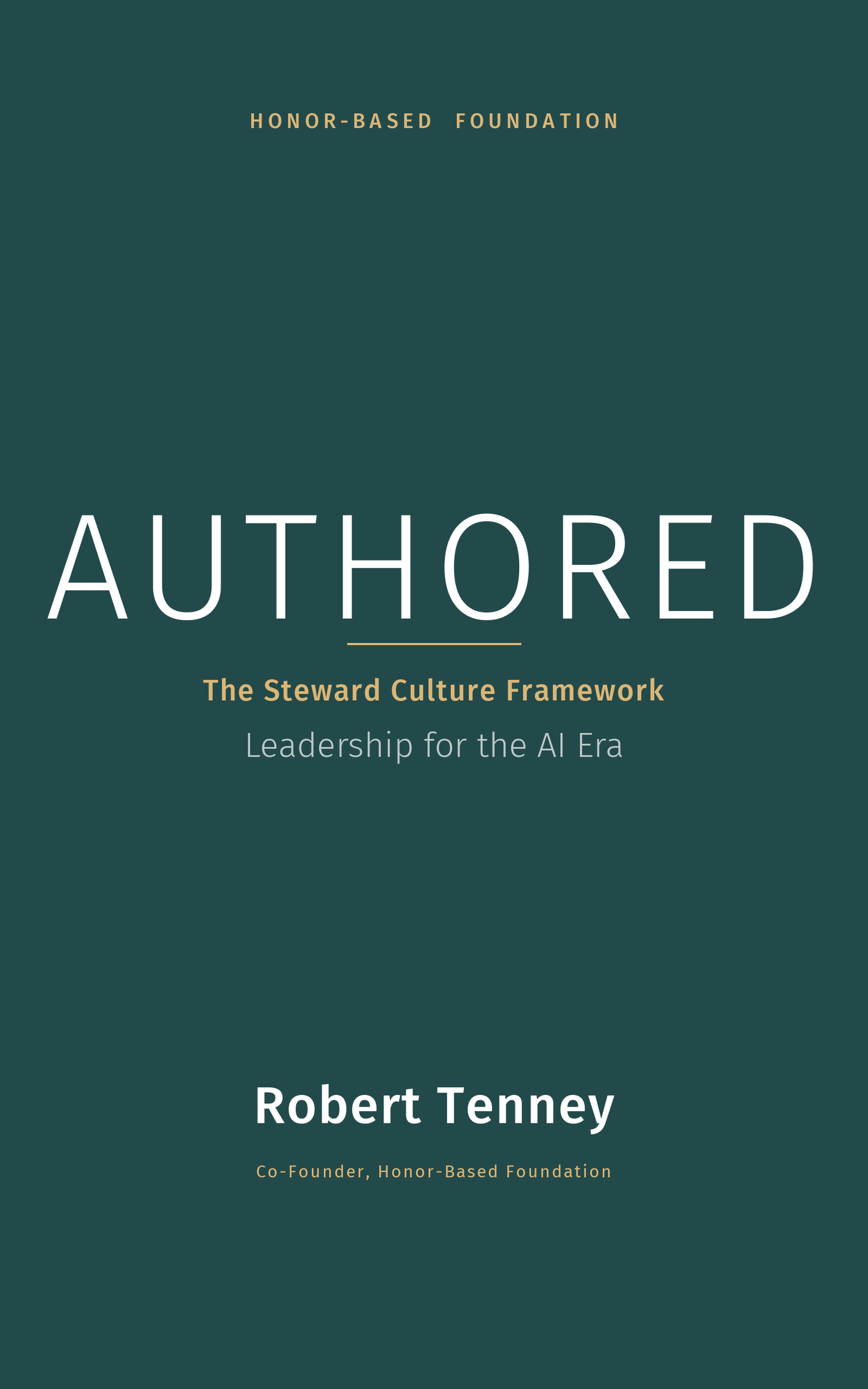
The complete framework for building a culture that is genuinely ready for AI, and for everything that comes after it. Thirteen chapters covering organizational authenticity, identity authorship, leadership identity, performance, incentive design, and misalignment.
Written for the leader who suspects the operating model they have run for twenty years is about to stop working.
Available now on Amazon in paperback and Kindle editions. The free toolkit is at honorbased.com/toolkit.
Every tier builds on the one before it. Most leaders start with the free toolkit. The ones serious about full implementation add the Practitioner Toolkit.
- Organizational Authenticity Canvas
- Leader Identity Workbook
- Identity Authorship Workbook
- Commitment Clarity Canvas
- Stewardship Conversation Canvas
- Development Conversation Canvas
- Incentive Clarity Review
- Identity Alignment Guide
- The eight core tools
- Leader Identity Workbook (Tool 02)
- Pre-Implementation Diagnostic
- Onboarding Protocol
- Tactical Implementation Plan
- Leader Binder, the master compendium
- 14 more implementation documents
- Starts where you are: agents, team changes or governance
- Builds on the people you already have
- An honest read from outside the building
- Full Steward Culture implementation when you are ready
Tell me where your organization is on the path, and I’ll tell you honestly what would help.
Tell Me Where You Are →Rather start on your own? The free toolkit is here.